
PLYNTUM vs Kantata
How PLYNTUM and Kantata differ in price, scope and language, with prices checked against Kantata’s own pages on 25 September 2026.
PLYNTUM or Kantata: the short answer
Kantata, formed from Mavenlink and Kimble, is professional services automation for larger organisations with tailored, unpublished pricing; PLYNTUM Core is a published $120 a month on annual billing for 10 members. Kantata groups people and projects by department or geography on Enterprise; in PLYNTUM each company is a separate workspace with its own plan. Pick Kantata for a large services organisation with Salesforce; pick PLYNTUM for a small agency that wants the price on the page.
Last checked: 25 September 2026.
Kantata and PLYNTUM at a glance
| Differentiator | Kantata | PLYNTUM |
|---|---|---|
| Pricing model | Custom quote; nothing published | Per workspace, members included: Launch 5, Core 10, Scale 25, Intelligence 50 |
| Cost for 10 people a month | Not published; quote required | $120 a month on Core, billed annually; $150 billed monthly |
| Time tracking | Time and expense entry across the product | All plans; private desktop capture is in development |
| Invoicing and receivables | Native invoicing; time and expenses can also be sent to QuickBooks | Basic invoices and receivables on all plans; draft invoices from approved time and recurring invoices from Core |
| Project profitability | Revenue-level financial management, built for larger organisations | From Core: logged hours at each person’s cost plus direct expenses, set against the project value |
| Georgian interface | Not found in the information we read | Georgian and English |
List prices from each vendor’s own pages, read on 25 September 2026; annual billing unless the cell says otherwise, before tax. The full feature table and the sources are further down.
Kantata, formed from Mavenlink and Kimble, presents itself as professional services automation for larger services organisations.
Not published. The pricing page says plans are tailored to company size and goals and asks you to talk to an adviser. The knowledge base refers to Enterprise and Premier accounts without prices.
Kantata for 10 users: not published. A quote is required.
PLYNTUM is business management software for agencies and service companies. It connects projects, clients, people, logged time and operational finance in one place.
- Launch
- $55 / month5 members included$44 / month, billed annually$528 paid yearly
- Core
- $150 / month10 members included$120 / month, billed annually$1,440 paid yearly
- Scale
- $450 / month25 members included$360 / month, billed annually$4,320 paid yearly
- Intelligence
- $1,050 / month50 members included$840 / month, billed annually$10,080 paid yearly
One subscription per workspace. Only Launch includes a 7-day free trial, with no automatic paid conversion. Capabilities differ by plan and role. CRM core is released; AI and CRM extensions have separate rollout gates.
Compare all plan capabilitiesPLYNTUM Core: $150 per month, or $120 per month billed annually ($1,440 paid yearly), for up to 10 members.
Feature by feature
| Area | Kantata | PLYNTUM |
|---|---|---|
| Pricing basis | Custom quote; nothing published | Per workspace: Core costs $150 per month for up to 10 members; $120 per month with annual billing |
| Projects and tasks | Task management and collaboration in one place; board types are not specified | All plans |
| Time tracking | Time and expense entry across the product | All plans; private desktop capture is in development |
| Time approval | Time approvals for project lead permission and above | Manager timesheet approval from Core |
| Invoicing | Native invoicing; time and expenses can also be sent to QuickBooks | Basic invoices and receivables on all plans; draft invoices from approved time and recurring invoices from Core |
| Expenses | Billable and non-billable expenses | All plans |
| Leave requests | Not stated on the pages we read | Leave requests with approval on all plans |
| Client access | Clients can be invited to the client side of a project | Scoped client portal from Core |
| Several companies | Organizations group projects and people by department or geography; Enterprise, or a paid add-on on Premier | A separate workspace per company, each with its own plan; one sign-in |
| Sales CRM | No native CRM; a Salesforce-based product and integrations instead | Released core; plan, role and permission limits apply |
| Georgian interface | Not found in the information we read | Georgian and English |
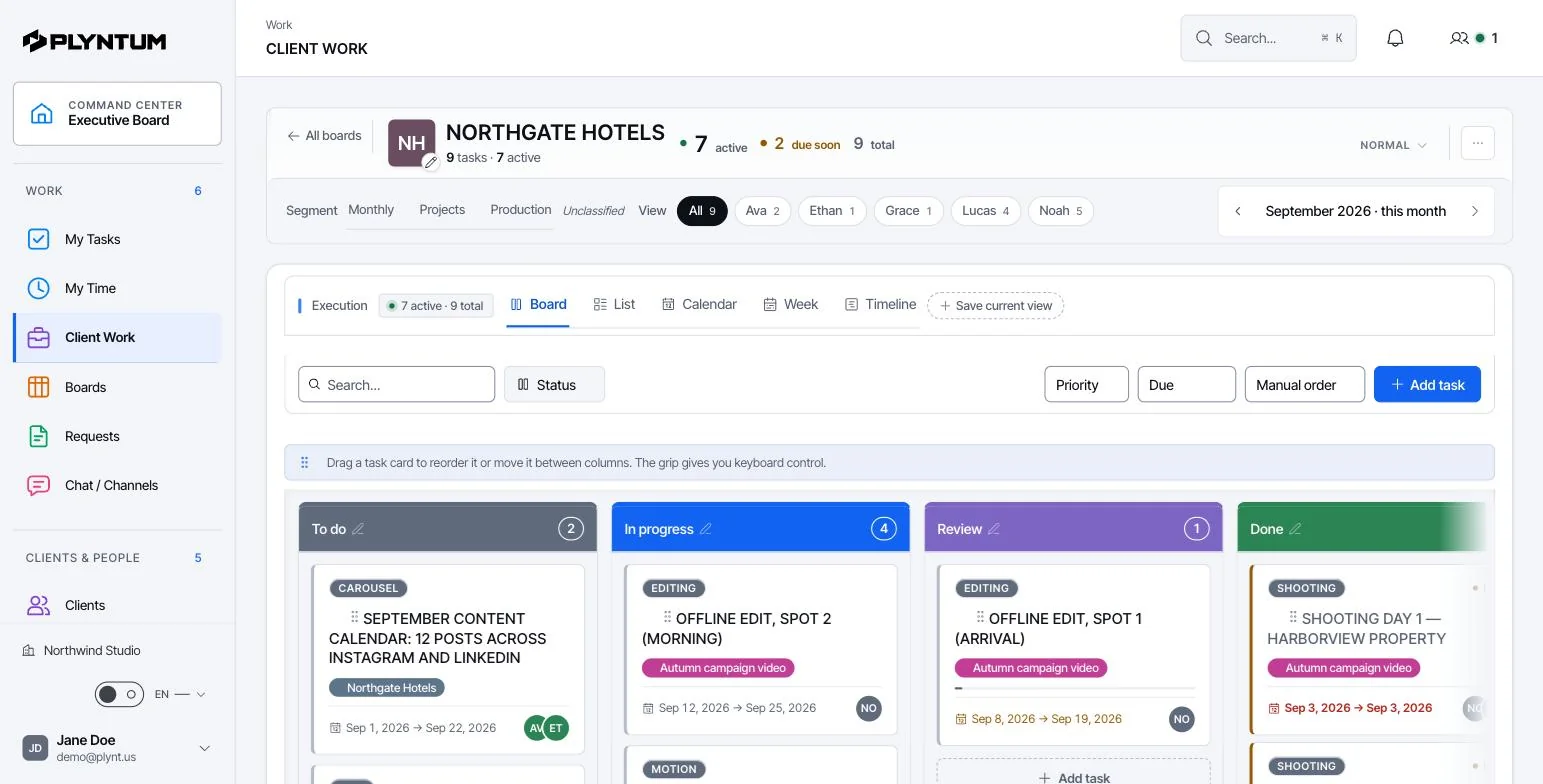
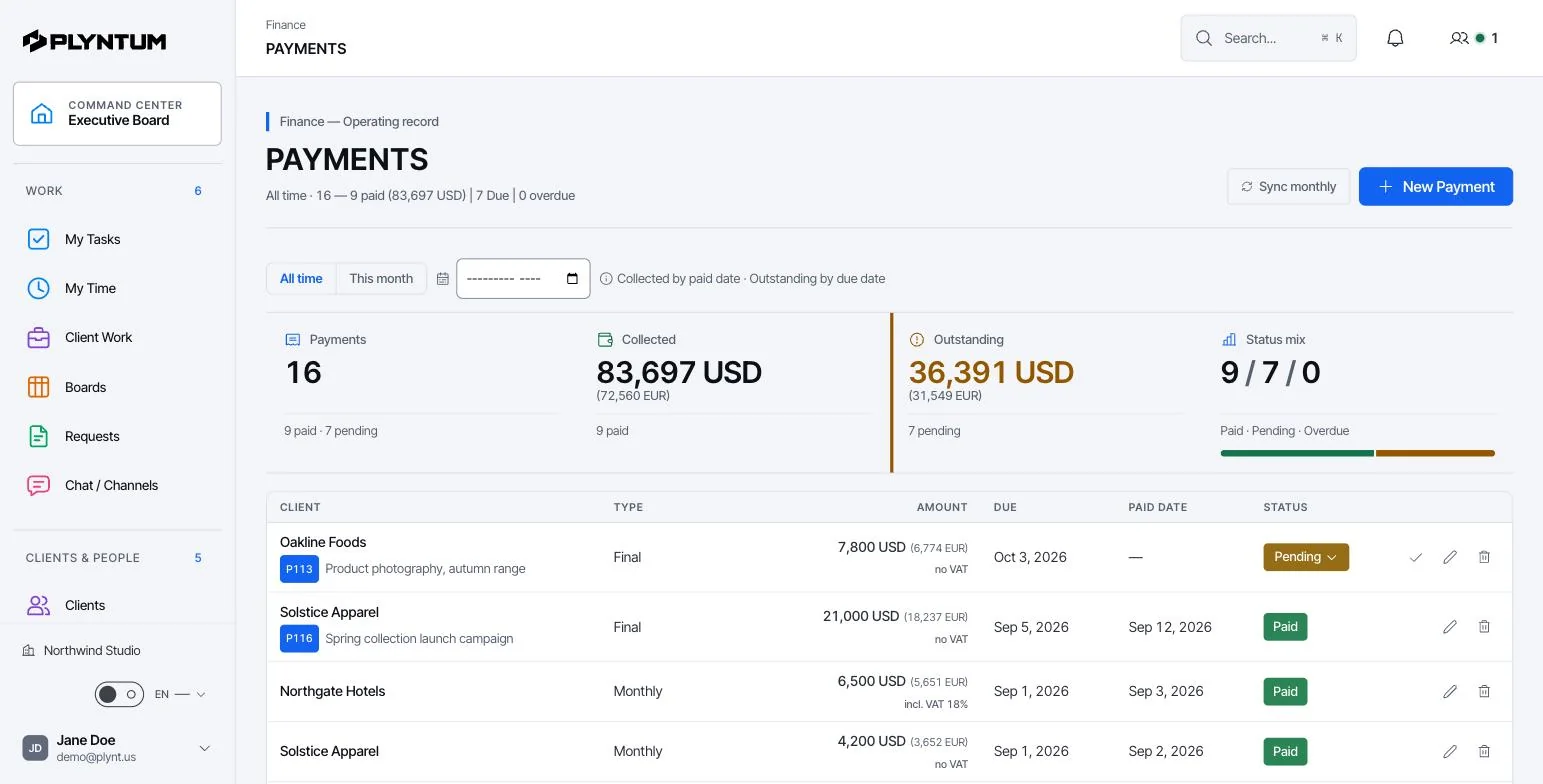
How it looks in PLYNTUM.
Screens from a demo workspace with sample data, as the product looks today.
Where Kantata is stronger
- Built for larger services organisations: resource forecasting, skills matching and revenue-level financial management.
- Organizations separate departments and geographies inside one account on the top tiers.
Where PLYNTUM fits better
- A published price and a trial you start yourself, instead of a quote and an onboarding project.
- Each company can be a separate workspace on any plan, with its own subscription, rather than a feature reserved for higher tiers.
- A Georgian interface alongside English.
A month of client work in Kantata and PLYNTUM
- Week 1: Kantata starts with an adviser and a tailored plan. PLYNTUM starts with a trial and a published price.
- Weeks 2–4: time and expenses are entered across Kantata, and project leads approve time. In PLYNTUM the manager approves timesheets from Core.
- Month end: Kantata invoices natively or sends time and expenses to QuickBooks, and forecasts revenue for larger organisations. PLYNTUM shows receivables and a 13-week cash flow overview from Core.
What to confirm with Kantata
- A quote for your headcount, and which tier includes Organizations.
- Whether you need skills matching and resource forecasting across departments.
- Where your CRM lives: Kantata relies on a Salesforce-based product and integrations.
Before you switch
Kantata is aimed at services organisations with dedicated resource and finance functions. If that is you, compare on a quote. If your company is closer to twenty people, compare PLYNTUM on published prices first.
Plan your moveCommon questions
Sources
Prices checked on 25 September 2026. Feature descriptions were reviewed on 11–12 September; pricing-related conditions were updated in this review. Competitor prices generally exclude tax; PLYNTUM uses its catalog amounts. Taxes are not normalized to one country. Confirm taxes, billing terms and the payable total with each vendor before deciding. If something has changed, tell us at info@plyntum.com.
Other comparisons
Start with the work that keeps getting stuck.
Bring one project into a connected workspace. See the work, the people and the cost together.