Best agency project management software (2026)
Agency project management software plans client work: briefs, tasks, owners, deadlines and the hours behind them. The best tools for agencies also connect those hours to cost and invoices, so you can say what a project earned. Fourteen tools are compared below on their own published prices and features, checked on 25 September 2026 (Productive, Teamwork.com, Bonsai, Paymo, Harvest and ClickUp prices on 24 October 2026).
Key facts
- Tools compared
- Fourteen agency project management tools, on published prices and features.
- Figures checked
- 25 September 2026, on each vendor’s own pages (Productive, Teamwork.com, Bonsai, Paymo, Harvest and ClickUp prices on 24 October 2026).
- PLYNTUM’s price
- $55 a month for 5 members, $150 for 10, priced per workspace.
- PLYNTUM’s gaps
- Payments are recorded manually; invoice drafts use approved time only, from Core; no native mobile app. Private desktop capture and AI analyses are not available today.
The short answer
Agency project management software plans client work: briefs, tasks, owners, deadlines and the hours logged against them. That is half of an agency’s job. The other half is money: what those hours cost, what was invoiced and whether the retainer still pays.
The 14 tools below differ less in task features than in how they charge, per user or per workspace, and how much of the money side they cover without a second product. A small team with simple finances can manage with a task tool and a time tracker. Once someone has to answer did this client make money this month, the task, the hour, its cost and the invoice belong in one system.
Agency project management vs agency management software
The two terms are often used as synonyms, but they cover different ground. Agency project management software runs the work: briefs, tasks, owners, deadlines, dependencies and usually the time logged on them. Agency management software runs the agency around that work: the same projects and hours, plus what each hour costs, invoices and payments per client, people and leave, and the margin per client and per project.
A project tool tells you whether the campaign launches on Thursday; an agency management system tells you whether the retainer behind it made money. Most tools here sit between the two: ClickUp leaves client invoicing to another system, while Workamajig keeps a full general ledger. If you are choosing the wider system, start with our page on agency management software. This guide compares the project side and how far each tool reaches into time, invoices and margin.
Five questions that decide the shortlist
- Per seat or per workspace? Ten people on a $24 seat cost $240 a month. The same ten on a flat workspace price cost what the workspace costs. Seat pricing also decides who you leave out.
- Does time get reviewed and approved? Recorded time and approved time are not the same number. If nobody reviews hours, the margin report inherits every mistake.
- Are invoices native or an integration? Several tools cover projects and time well and then hand invoicing to an accounting product. That is a workable answer, but it is a second system.
- One company or several? Separate legal entities, separate books and one login is a requirement that eliminates most of the list quickly.
- Will the team actually enter time? The most complete system is worth nothing if the hours arrive on Friday from memory.
Agency project management software compared: published prices
List prices before tax, as checked on each vendor’s pricing page on 25 September 2026 (Productive, Teamwork.com, Bonsai, Paymo, Harvest and ClickUp on 24 October 2026). Where a vendor publishes nothing, the cell says so rather than guessing. Prices change; check the vendor's page before you decide.
| Tool | Pricing basis | Entry list price | Free trial | Invoicing | Profitability reporting |
|---|---|---|---|---|---|
| PLYNTUM | Flat per workspace | $55 a month for 5 members ($44 billed annually) | 7 days on Launch only | Basic invoices on all plans | Core and above: $150 monthly, or $120 per month billed annually |
| Productive | Per user | $10 per user (Essential, annual) | 14 days | Yes | Yes |
| Scoro | Per user, bought as app bundles | from €15 per user, minimum 5 users | 14 days | Yes | Yes |
| Teamwork.com | Per user, seat minimums; free plan | $9.99 per user (Basics, annual, minimum 3) | 14 days | Basic invoices on Accelerate; margin, tax and discounts on Optimize | Time budgets from Accelerate; cost budgets and profitability from Optimize |
| Workamajig | Per user, minimum 10 | $49 per user for 10 or more | Not stated | Yes, with a general ledger | Yes |
| Function Point | Per user | $53 per user (Standardize, annual as published) | Not stated; an onboarding fee is | Yes, batch invoicing | Yes |
| Accelo | Custom quote | Not published | Not stated | Yes | Yes |
| Kantata | Custom quote | Not published | Not stated | Yes | Yes |
| Streamtime | Fixed price, no per-user fee | Not published | Offered, length not stated | Yes | Yes |
| Ravetree | Per user | $29 per user (annual) | Offered, length not stated | Yes | Yes |
| Bonsai | Per user | $9 per user (Basic, annual) | 7 days | From Essentials | From Premium |
| Paymo | Per user, free plan | $15.90 per user (Plus, monthly) | 15 days | Yes | From Plus |
| Harvest + Forecast | Per seat, free plan | $9 per seat (Teams, annual) | 30 days | Yes | From Enterprise |
| ClickUp | Per user, free plan | $9 per user (ClickUp Core, annual) | Free plan, no trial stated | No native client invoicing stated | Billable time from Business |
Two neighbouring categories often appear on the same shortlist. Resource planners such as Float (from $7 per scheduled person a month, billed annually) and Resource Guru (from $5 per person) schedule people well and do not publish invoicing. General project tools such as monday.com and Asana do not list client invoicing in their plans at all; we compare them separately in PLYNTUM vs monday.com and PLYNTUM vs Asana.
The 14 agency project management tools, one by one
For each tool: what it is, who it suits, the published price for ten users with the day we read it, the agency features the vendor documents and one limitation. Prices exclude tax. Features missing from the vendor’s pages are left out, not assumed.
PLYNTUM
Business management software for agencies and service companies, priced per workspace.
- Best for: agencies that want work, time and operational finance in one workspace, in English or Georgian.
- 10 users: Core, $150 a month or $120 billed annually; a 7-day trial on Launch, no card.
- Agency features: list, board, calendar and timeline views; a timer or manual time entry on every plan; timesheet approval, project profitability, recurring invoices, draft invoices from approved time and a read-only client portal from Core; resource planning from Scale.
- Limitation: no online payments, and invoice drafts use approved time only, from Core; no native mobile app.
Productive
Agency software for resources, projects and finances.
- Best for: agencies that want resource planning and a sales pipeline in one tool.
- 10 users: $250 a month on Professional ($100 on Essential), billed annually; minimum 3 seats (read 24 October 2026).
- Agency features: invoicing and resource planning on every plan; billable-time approval and client access to budgets from Professional.
- Limitation: the interface is in English only.
Scoro
Projects, resourcing and finances, sold as app bundles.
- Best for: firms with a finance team that needs quoting and work-in-progress reports.
- 10 users: €250 a month on Quote to Cash or €520 on End-to-end at the displayed rates, before onboarding; minimum 5 users; billing cycle not labelled (read 25 September 2026).
- Agency features: time locking, invoicing, expenses, time off and a sales CRM.
- Limitation: the customer portal and extra company entities are paid add-ons.
Teamwork.com
Projects, resources and financials for client services; free plan for up to 5 users.
- Best for: teams that start with project delivery and add the finance side later.
- 10 users: $249.90 a month on Accelerate, billed annually; minimums of 3 users on Basics and 5 on Accelerate (read 24 October 2026).
- Agency features: timesheets, time budgets, time-based retainers and basic invoices from Accelerate.
- Limitation: timesheet approval and profitability need Optimize, which is priced on request.
Workamajig
Agency management software for ad and marketing agencies, with accounting and CRM.
- Best for: agencies of ten or more that want accounting and proofing in one system.
- 10 users: $490 a month billed monthly, or $5,390 a year on the annual offer; minimum 10 users (read 25 September 2026).
- Agency features: time approval before billing, a full general ledger, client proofing and separate books per company.
- Limitation: implementation is stated as 2–3 months.
Function Point
Agency management software for creative and marketing agencies.
- Best for: agencies that want a guided rollout and one process from brief to invoice.
- 10 users: $530 a month on Standardize, billed annually, plus an onboarding fee (read 25 September 2026).
- Agency features: Gantt chart and Kanban board, creative briefs, batch invoicing, estimates and resource forecasting by role.
- Limitation: no free trial is stated.
Accelo
Professional services automation for client work, from quote to invoice.
- Best for: established service firms that manage retainers, contracts and tickets.
- 10 users: not published; the price comes with a demo or a quote (read 25 September 2026).
- Agency features: Gantt charts, weekly timesheet approval, automated invoicing and a client portal with quote acceptance.
- Limitation: no published price, plan names or trial.
Kantata
Professional services automation for larger services firms.
- Best for: organisations with dedicated resource and finance teams.
- 10 users: not published; plans are tailored after a conversation with an adviser (read 25 September 2026).
- Agency features: resource forecasting, skills matching, time approvals, native invoicing and client access to projects.
- Limitation: no native CRM; Kantata relies on a Salesforce-based product and integrations.
Streamtime
Job management for creative studios, priced on usage rather than per user.
- Best for: studios whose workload and freelancer count vary.
- 10 users: not published; Streamtime quotes after a form on team size, freelancers and annual revenue (read 25 September 2026).
- Agency features: scheduling, time tracking, expenses and invoicing with Xero, QuickBooks and MYOB sync.
- Limitation: no time approval or client access on the pages we read.
Ravetree
A work-management suite for agencies, sold as one plan.
- Best for: agencies that want every feature without moving up a tier.
- 10 users: $290 a month billed annually, or $390 on monthly billing (read 25 September 2026).
- Agency features: planning views, time tracking, expenses and invoicing with two-way QuickBooks and Xero sync.
- Limitation: no time approval, client access or CRM on the pages we read.
Bonsai
Proposals, contracts, invoices and projects for small agencies and independents.
- Best for: one person or a pair who sell with proposals and contracts.
- 10 users: $90 a month on Basic, $190 on Essentials (invoicing), $290 on Premium (profit reporting), billed annually (read 24 October 2026).
- Agency features: e-signatures, time tracking, expenses, and invoices with time entries attached from Essentials.
- Limitation: the pricing page lists no timesheet approval.
Paymo
Work management with time tracking and invoicing for small teams.
- Best for: small teams that want a cheap start with invoicing included.
- 10 users: $159 a month on Plus at the standard monthly price, $109 billed annually (read 24 October 2026).
- Agency features: invoicing on every plan; recurring invoices and project profitability from Plus.
- Limitation: timesheet approval needs Pro: $239 a month for ten at the standard monthly price.
Harvest + Forecast
Time tracking with invoicing; Forecast adds resource planning as a separate product.
- Best for: teams whose main problem is getting hours recorded and invoiced.
- 10 users: Teams from $90 or Enterprise from $140 a month, billed annually, plus usage fees; Forecast adds $50 (Harvest read 24 October 2026, Forecast 25 September 2026).
- Agency features: invoicing on every plan, Free included; payment integrations such as Stripe from Teams; timesheet approval and profitability on Enterprise.
- Limitation: the prices are floors: extra invoices, projects, clients and tasks are billed by use.
ClickUp
Tasks, docs, goals and chat for any kind of team, not agencies in particular.
- Best for: teams that want flexible task management and invoice in another tool.
- 10 users: $170 a month on Business, $90 on Core, billed annually; free plan available (read 24 October 2026).
- Agency features: many views, time tracking from Core, timesheets from Business and timesheet approval on Enterprise.
- Limitation: no native client invoicing is stated.
Which tool suits which agency
Under ten people, watching every dollar. The shortlist includes PLYNTUM, Bonsai, Paymo and Harvest with Forecast. Productive Essential also publishes its prices, with a three-seat minimum. Workamajig starts at ten users and Scoro at five.
Resource planning is the daily problem. Scoro, Productive and Kantata are built around utilisation and capacity; a dedicated planner alongside a lighter tool is the other route. Our guide to PSA software for agencies compares that end of the market on price for ten people.
You need a sales pipeline too. Productive, Function Point and Accelo carry one today. CRM core is released, subject to plan, role and permissions. Proposal drafts, won-deal handoff and manual forecasts have plan limits; inbox and integrations require separate setup. AI and private capture remain in development. Review CRM access and limits.
Several companies under one roof. Workamajig keeps separate books per company, Scoro sells extra entities as an add-on, Kantata groups work by department or geography on its top tiers, and PLYNTUM gives each company its own workspace under one login.
Marketing agency project management software
Marketing agency project management software carries three kinds of work at once: campaigns with a launch date and dependencies (copy before design, design before launch), retainers that repeat every month and have to fit their fee, and client approvals that often run to rounds nobody priced.
Any tool here with dependencies and a timeline or Gantt view handles campaigns. For retainers, check where the hours meet the fee: Teamwork.com tracks retainers by time on Accelerate and by time and cost on Optimize, and Accelo’s quote-to-invoice workflow covers retainers and contracts. In PLYNTUM, recurring task templates set up each retainer month, hours roll up from the task to the client, and recurring invoices go out on schedule from Core. For approvals, Workamajig includes client proofing; PLYNTUM keeps comments and approvals on the task, but its client portal is read-only and it has no proofing tool.
PLYNTUM does not connect to ad platforms or schedule posts. More on retainer work in PLYNTUM for marketing agencies, and on monthly SEO work in software for SEO agencies.
What PLYNTUM covers, and what it does not
PLYNTUM is business management software for agencies and service companies: project boards, client records, time tracking with weekly approval from Core, project profitability, invoices, expenses, receivables, requests and approvals, and a separate workspace per company. It is priced per workspace, from $55 a month for five members, and it works in English and Georgian.
Know its limits before you compare. From Core, invoices can be drafted from approved, billable time only; on Launch they are written with free-form lines. Payments are recorded manually, with no online collection. There is no native mobile app, no proofing tool and no ad-platform connection. Team-wide resource planning starts on Scale ($450 a month for 25 members). It is not accounting software: invoices, payments and expenses export as CSV for your accountant.
CRM core is available to eligible users. Private desktop capture and AI analysis are not available today. Those are in development and buying a plan does not unlock them. If an advanced sales pipeline, with inbox sync and automated sequences, is the main reason you are shopping, a dedicated CRM serves you better today.
See the numbers side by side in the comparisons, or work out what your current stack costs in the stack calculator.
By the kind of company you run
The same five questions land differently depending on what you sell. These pages take them one kind of company at a time, including what PLYNTUM does not cover for each: creative and design studios, marketing agencies on retainer, video production companies and consulting firms.
Questions people ask
What is agency project management software?
Software that plans and tracks client work in an agency: briefs, tasks, owners, deadlines, dependencies and, usually, the time logged on them. Tools built for agencies add what general task apps leave out, such as retainer work that repeats every month, client access and a link from hours to invoices. When the same system also runs cost, invoices, people and margin, it is usually called agency management software.
How much does it cost for a team of ten?
On per-user pricing, ten people pay for ten seats. Billed annually, that is $100 a month on Productive Essential, $170 on ClickUp Business, $249.90 on Teamwork.com Accelerate, $250 on Productive Professional and $290 on Ravetree; Workamajig is $490 billed monthly (read 25 September 2026; Productive, ClickUp and Teamwork.com on 24 October 2026). PLYNTUM Core covers ten members for $150 a month, or $120 billed annually. For 15 people, see what business software costs a 15-person team.
Is a project management tool enough?
For planning, often yes. For money, no. Asana and monday.com do not list client invoicing in their plans, so the invoice, the cost of the hours and the margin end up in a spreadsheet, where nobody updates them between month-ends.
What does per-workspace pricing change?
Who you invite. When a seat costs money, the designer who logs four hours a week, the accountant and the client stay outside the system, and the data inside it is incomplete. A flat workspace price removes that decision.
Sources
Every figure on this page comes from the vendor's own pricing or help pages, checked on 25 September 2026 (Bonsai, ClickUp, Harvest, Paymo, Productive and Teamwork.com prices on 24 October 2026). If something has changed, tell us at info@plyntum.com and we will correct it.
Related pages
- Agency management software for marketing, creative and digital agencies
- Best PSA software for agencies and professional services firms (2026)
- Retainer management software for agencies
- What business software costs a 15-person service team in 2026
- PLYNTUM for project managers
- PLYNTUM for finance teams
- Best project management software in 2026: 9 tools compared
- What is business management software? Types, costs and how to choose (2026)
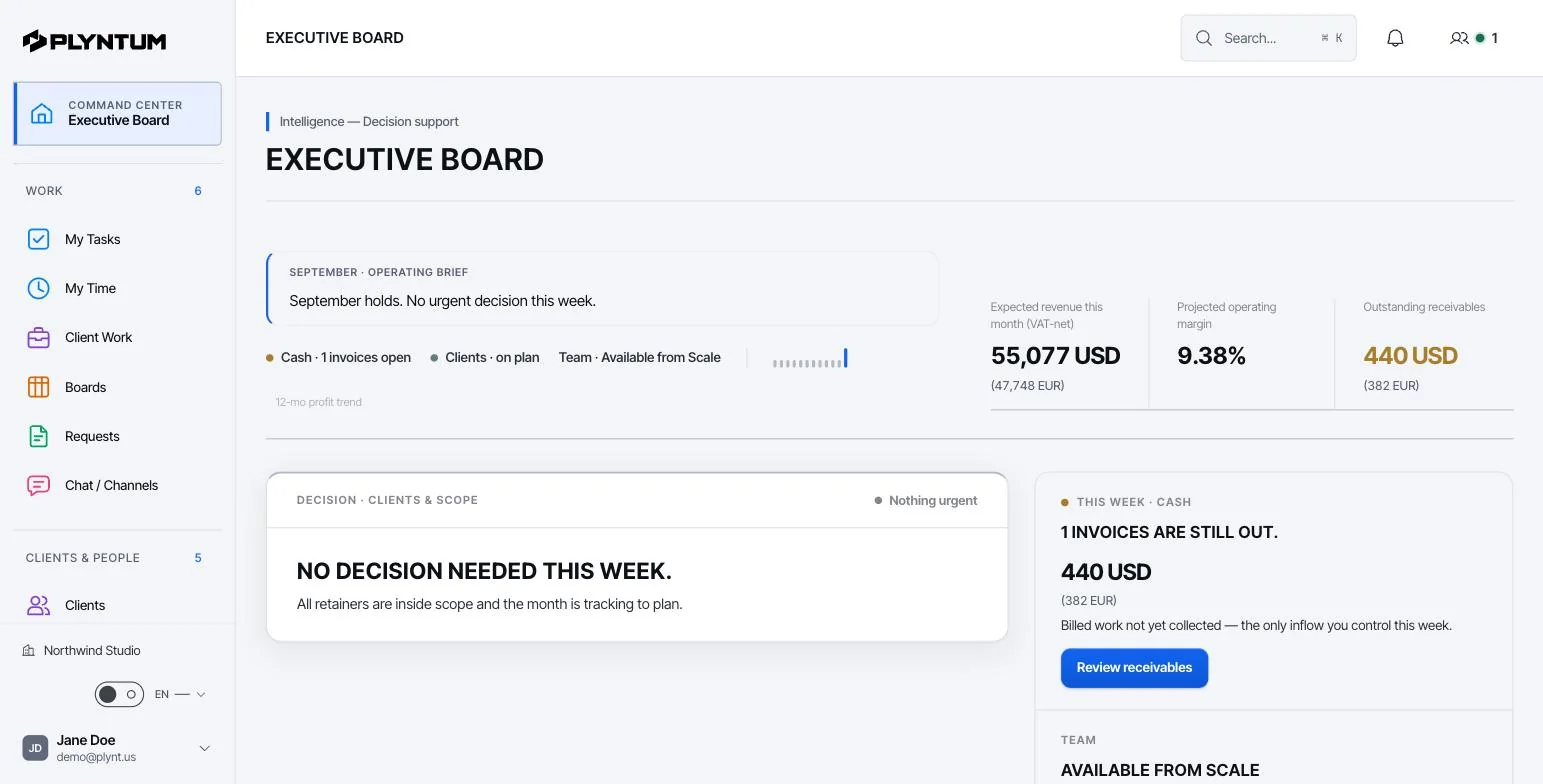
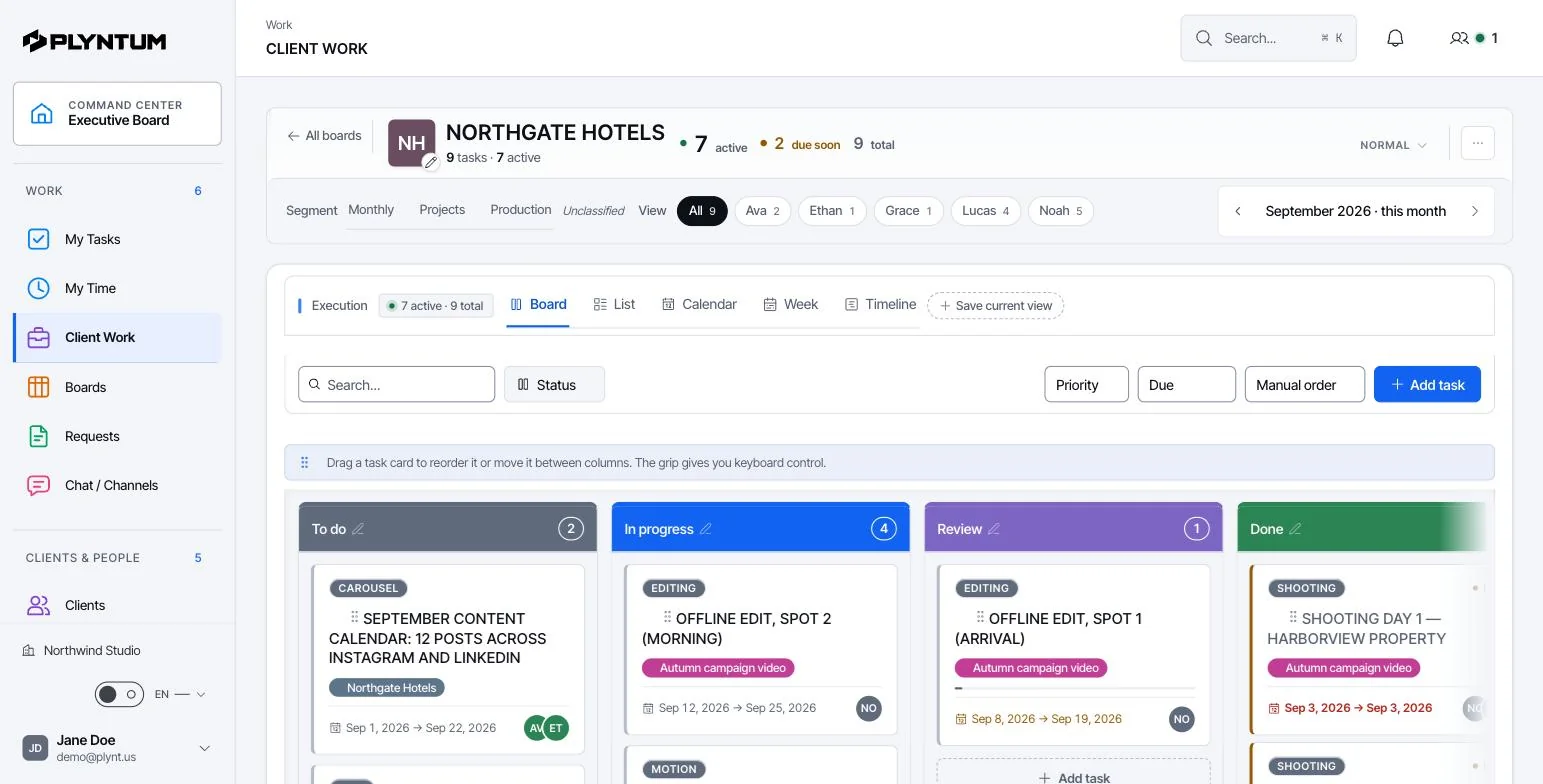
How it looks in PLYNTUM.
Screens from a demo workspace with sample data, as the product looks today.
Start with the work that keeps getting stuck.
Bring one project into a connected workspace. See the work, the people and the cost together.