
Marketing agency software for retainer work
PLYNTUM is software for marketing agencies that work on retainer: projects and tasks, logged hours, client records, recurring invoices and expenses in one workspace, so you can see each client’s hours against its fee while the month is still running. It is priced per workspace, not per user, and it is not accounting software.
Key facts
- Built around
- Hours per client per month against the retainer they were assumed for.
- Billing
- Recurring invoices issue on schedule; pass-through costs sit on the same client.
- Several brands
- A separate workspace per company or legal entity, under one login.
- Not included
- No ad-platform connections, post scheduling or campaign reporting today. CRM core has plan and role limits.
How it looks in PLYNTUM.
Screens from a demo workspace with sample data, as the product looks today.
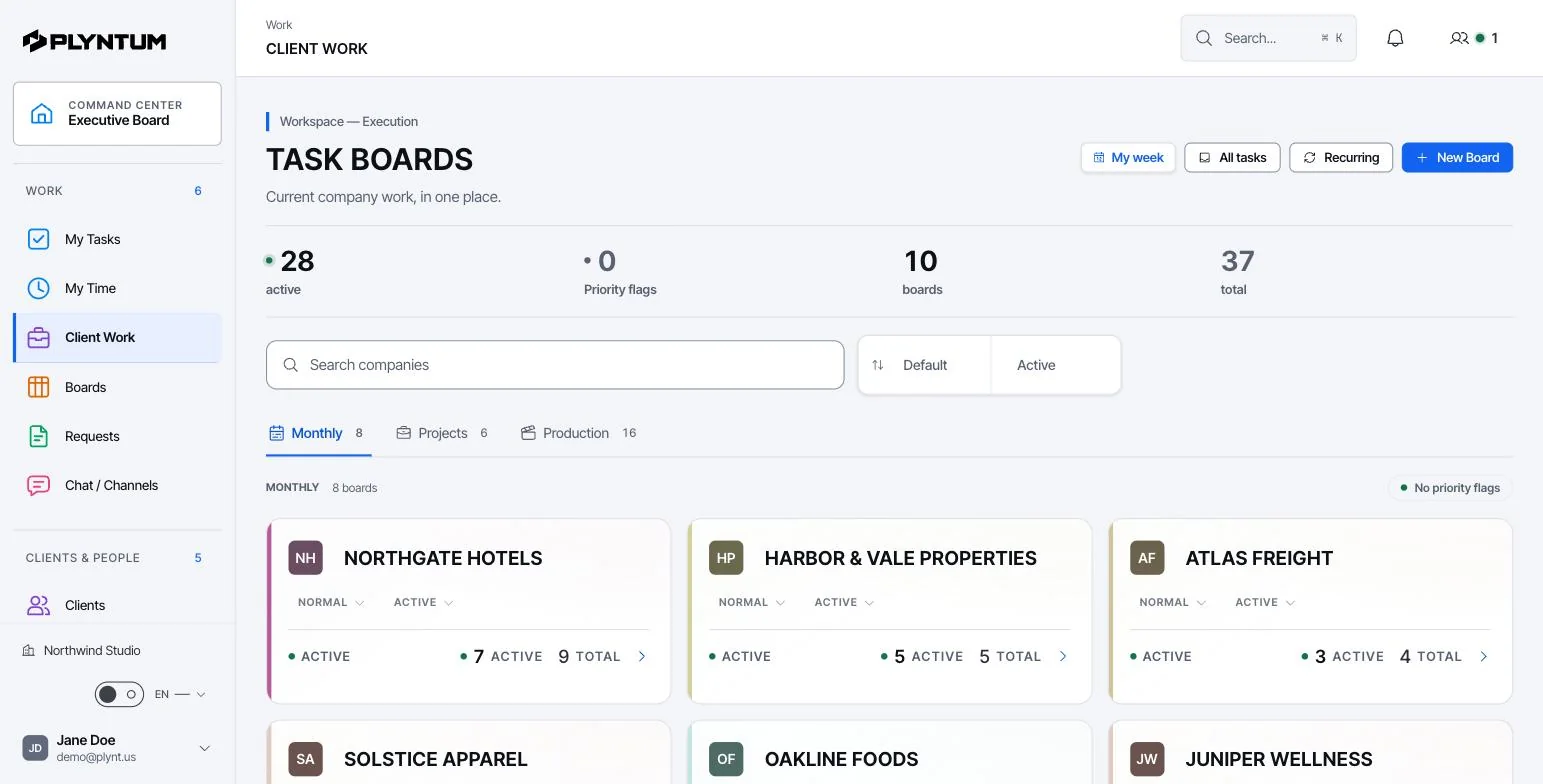
A closer look.
The details behind the workflow, including what is available and what is still planned.
PLYNTUM is software for marketing agencies that work on retainer. Each client can carry a monthly retainer fee and monthly deliverables, such as 12 posts with an estimated time each, and PLYNTUM creates that month’s tasks from them. Hours logged on those tasks are recorded against the retainer, so you can see what each client’s work took while the month is still running. From Core ($150 a month for up to 10 members, or $120 billed annually), a recurring invoice creates the monthly invoice on schedule, and a read-only client portal shows the retainer, deliverables, invoices and balance. PLYNTUM is not accounting software and does not run ad campaigns.
The contract says a monthly fee for an agreed scope. Then a client adds a channel. Someone asks for a weekly report instead of a monthly one. A campaign launch moves and two people spend a Saturday on it. None of that is refused, and none of it changes the invoice.
By the fourth month the retainer covers about half the hours it did in the first, but the invoice is identical, and the only person who suspects it is the account manager who keeps working late.
Retainers do not fail loudly. They erode, and the erosion is only visible if hours are attached to the client every week rather than remembered at renewal.
Fees, monthly deliverables, recurring invoices and renewals in one place: retainer management software.
- Hours per client per month, against the hours the fee assumed.
- Who the hours belong to. Two junior hours and two director hours cost different amounts; a headline total hides that.
- Recurring invoices that issue themselves, so billing is not a monthly memory test.
- Media and tool costs passed through, on the same client as the work.
- The renewal date, with the year of hours behind it, ready before the conversation and not after.
Each client is a record with its projects, hours and money attached. Time goes to a task, the task to a project and client, so a monthly figure per client needs no re-entry. Recurring invoices issue on schedule and sit next to the expenses for that client.
Because loaded hourly cost is calculated per person, the report distinguishes a month of junior production from a month of senior strategy. The client report shows the hours behind the margin, which is what a renewal conversation actually needs.
Agencies that run two brands, or a separate legal entity for media buying, get a workspace per company, each with its own plan, under one login.
Customer story: Lost & Found, 22 retainer clients and 18 people, replaced Asana, Slack, Excel and Notion with PLYNTUM in 10 days. Lost & Found’s CEO is PLYNTUM’s founder.
Marketing agency project management software has to run two rhythms at once: campaigns with a launch date, and retainer work that repeats every month. In PLYNTUM both sit under the client as projects. Campaign tasks get owners, deadlines and dependencies (copy before design, design before launch) and show on a board, a calendar or a timeline. Monthly content, reporting and account management come from recurring task templates, so each retainer month starts with its tasks already in place.
A new channel is agreed with the client before anyone works on it, then added as its own tasks. Hours go on the same tasks, which is what makes a retainer month measurable. SEO retainers follow the same pattern with a heavier reporting load; see PLYNTUM for SEO agencies. PLYNTUM does not schedule posts or pull campaign data.
The figures below are an example, not a benchmark. The client pays $6,000 a month, and you priced it at 60 hours. Your blended cost — salaries and overheads spread across the people doing the work — is $38 an hour. By month 4 the client has added a channel and a weekly report, and the month closes at 88 logged hours.
| Per month | As planned | Month 4 |
|---|---|---|
| Logged hours | 60 | 88 |
| Cost at $38 an hour | $2,280 | $3,344 |
| Margin on the $6,000 fee | $3,720 (62%) | $2,656 (44%) |
| Fee earned per hour worked | $100 | $68 |
The invoice did not change. Twenty-eight extra hours cost $1,064 and cut the margin from 62% to 44%. Earning the planned $100 an hour on 88 hours would take a fee of $8,800. PLYNTUM holds cost per person, so extra senior hours show a steeper fall.
What the account lead does in week 2. With time logged daily, the client report shows 44 logged hours after two weeks: nearly three-quarters of the plan, with half the month left. That is the time to act, not renewal. Open the hours by task, see that the weekly report and the new channel carry most of the overrun, and agree one of three things with the client: the extra work moves to a separate estimate, the scope returns to what was signed, or the fee changes from the next invoice — with the hours to show why.
Work out your own loaded hourly cost with the hourly rate calculator, and read how scope creep builds up on a retainer.
Retainers are usually priced on production: posts, ads, landing pages, emails. The hours that go missing sit around it, every month, whether the client adds anything or not. Say one client’s month includes:
- a monthly report that takes 6 hours to pull together and write up;
- a one-hour weekly status call with three people from your side: 12 hours;
- a dozen “quick” requests by email and chat at 15 minutes each: 3 hours.
That is 21 hours in a four-week month — more than a third of a 60-hour retainer before a single post goes out. None of it is wasted; clients value the report and the call. But it is rarely planned, so rarely priced, and because it is not production it is the first thing people forget to log.
Record it against the client. In PLYNTUM, create reporting, meeting and account management tasks on the client’s retainer project, and set the monthly report up as recurring work. People log time to them like any other task; a manager approves the timesheet (Core and above), which locks the week; every logged hour counts as cost on that client. At month end you can see how much of the retainer went on reporting and meetings rather than production — the number to bring to a renewal.
Time is entered by hand; PLYNTUM has no automatic desktop capture today, so a short entry each day beats a Friday reconstruction. More on time tracking and approval and the hours that never get logged.
Around a retainer fee sit costs you pay on the client’s behalf: a social listening licence, stock images, a freelance copywriter or photographer for one campaign, sometimes the media budget itself. Left in a general expenses spreadsheet, they make the client look more profitable than it is, and the ones you meant to re-bill get forgotten.
In PLYNTUM each is an expense on the client and project it belongs to: the freelancer’s invoice on the spring campaign, the monthly licence on the retainer. Project profitability counts direct expenses next to logged hours, so the margin you see already includes them.
Keep media spend on its own project under the same client. Re-billed at cost, $20,000 of media adds nothing to your margin. Mixed into the retainer’s figures, it turns the 44% margin above into about 10%: the same $2,656 on $26,000 of billing.
From Core, the fee itself can go out as a recurring invoice each month; re-billed costs go on an invoice to the same client, so both sit in its receivables.
What it does not do. PLYNTUM does not connect to Meta, Google or any other ad platform, and does not report on campaign performance; spend is entered as an expense, not pulled in. It is not accounting software — no ledger, bank feeds, tax filing or payroll — so your accountant’s system stays. See invoices, expenses and receivables.
Marketing agency management software is easy to demo. Whether it is sold as agency management, project management software for marketing agencies or an all-in-one platform, the differences show up in month six, when the team has grown and the retainers have drifted. Six questions to ask any vendor, PLYNTUM included:
- What will it cost at your size in two years? Per-user pricing grows with every hire: a $25 per-user plan is $250 a month at 10 people and $625 at 25. PLYNTUM is priced per workspace, members included: Core is $150 a month for 10, Scale $450 for 25.
- Is time reviewed every week? Unreviewed hours turn margin reports into guesses. PLYNTUM: manager approval of timesheets, from Core.
- Can you see each retainer by client and month, against plan, without a spreadsheet export? PLYNTUM: hours roll up from task to project and client.
- Is there a client portal, and what does the client see? PLYNTUM: a scoped client portal, from Core.
- Do recurring invoices issue themselves? On a retainer, billing should never depend on memory. PLYNTUM: yes, from Core.
- Can it hold more than one company? A second brand or a media-buying entity needs its own clients, members and permissions. PLYNTUM: a separate workspace per company, each with its own plan, and one login to switch between them.
CRM core is released, subject to plan, role and permissions. Proposal drafts, won-deal handoff and manual forecasts have plan limits; inbox and integrations require separate setup. AI and private capture remain in development. Review CRM access and limits.
It does not connect to ad platforms, schedule posts or report on campaign performance. Ad spend enters as an expense; it is not pulled from Meta or Google. PLYNTUM CRM core is released for eligible workspace users; plan, role and permission limits apply. Won-deal handoff starts with Core and requires permission.
It is not accounting software, and it submits nothing to a tax authority.
Can it tell me whether a retainer is profitable?
It shows the logged hours and direct costs against what the client was invoiced, per month and per project. It does not decide what “profitable enough” is — the margin target is yours.
We bill some clients hourly and some on retainer.
Both sit on the same client record. The difference is in how the invoice is raised, not in how the hours are captured.
How many clients can one workspace hold?
Client and project allowances differ by plan; the current limits are on the pricing page. The member count is what the price is based on, not the client count.
Still choosing between tools? The 2026 comparison guide reads fourteen of them on their own published prices, and the comparison pages go tool by tool.
Common questions
Start with the work that keeps getting stuck.
Bring one project into a connected workspace. See the work, the people and the cost together.