
Free leave order template for Georgia (Word)
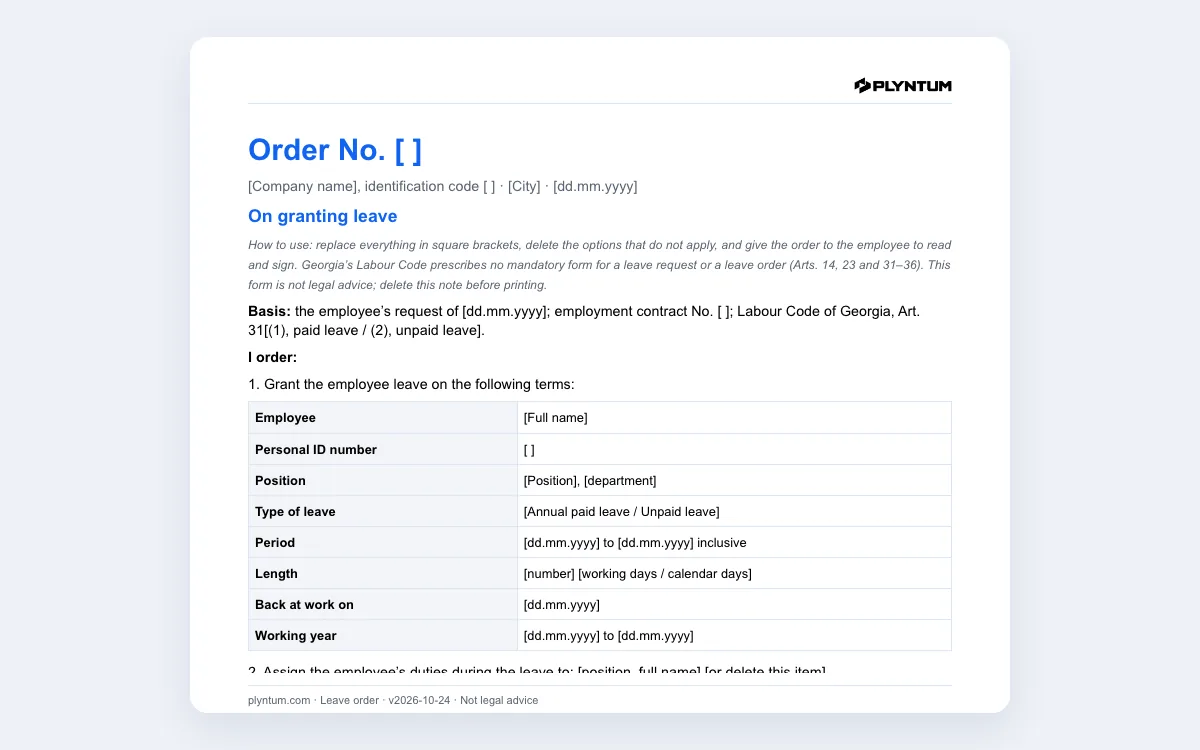
Download a free leave order in Word: the document with which an employer in Georgia grants an employee annual paid or unpaid leave, called შვებულების ბრძანება in Georgian. It names the employee, the type of leave, the dates and the number of days, who covers the work and how pay is handled, and ends with the employer’s signature and the employee’s. In English, in Georgian, and in Georgian and English side by side.
Free, no sign-up · .docx, no macros · opens in Google Docs and Pages · not legal advice
Key facts
- Format
- Word (.docx) with no macros, in English, in Georgian, and in Georgian and English side by side.
- What it covers
- Annual paid or unpaid leave: dates, days, cover, pay and both signatures.
- Status
- Not a state form: the Labour Code of Georgia sets no mandatory form for a leave request or order (Arts. 14, 23 and 31–36). Not legal advice.
- Not included
- Maternity, childcare and other leave, the leave pay calculation and legal advice.
Word · .docx, no macros · opens in Google Docs and Pages · not legal advice
Georgian and English · Georgian left, English right · .docx, no macros · not legal advice
Leave, remote work and equipment requests on paper? In PLYNTUM each request goes to a manager with the decision on record, and approved leave shows in the workload view, so cover is planned, not improvised.
What a leave order is
In Georgia, leave can be documented with two papers: the employee’s request (განცხადება) and the employer’s order (ბრძანება) that grants the leave. The Labour Code prescribes no mandatory form for either (Labour Code, Arts. 14, 23 and 31–36). The leave procedure belongs in the employment contract (Art. 14(1)(h)) and may also be written into the internal regulations (Art. 23(2)).
An order is still worth having: in a dispute, a written trail protects both sides. The request shows what the employee asked for and when; the order shows what the employer decided. The leave request form and the unpaid leave request are the employee’s side, and this template is the employer’s.
What is in the leave order
The order opens with the company and its identification code, the order number, the city and the date, the subject (“On granting leave”) and the basis: the employee’s request, the employment contract and the article of the Labour Code. Then:
- The terms: employee, personal ID number, position, type of leave (annual paid or unpaid), period, length in working or calendar days, the day back at work and the working year the leave belongs to.
- Cover: who takes on the employee’s duties, or delete the item.
- Pay: for paid leave, who calculates and pays the leave pay; for unpaid leave, that no pay is due unless the law or the contract says otherwise.
- Signatures: the employer’s signature, with a stamp if the company uses one, and the employee’s signature with the date they read the order.
- For the records: the paid leave balance before the order, the days it grants, what remains, and the timesheet code.
Three files: English (plyntum-leave-order.docx), Georgian (plyntum-shvebulebis-brdzaneba.docx), and Georgian and English side by side for companies whose managers read English. A grey note at the top explains how to use the file; delete it before printing.
How to fill it in
- Start from the employee’s request. Copy the dates from it and write its date in the basis.
- Choose the type of leave and delete the other option. The Code counts paid leave in working days, at least 24 a year (Labour Code, Art. 31(1)), and unpaid leave in calendar days, at least 15 a year (Art. 31(2)). Write the length in the same unit.
- Check the timing. The right to request leave arises after 11 months of work, although by agreement leave can be granted earlier (Art. 32(1)). Unless the contract says otherwise, the employer sets the order in which people take paid leave during the year (Art. 32(5)). By agreement, leave can be split into parts (Art. 32(3)). Before unpaid leave, the employee warns the employer 2 weeks in advance, except when urgent medical need or family circumstances make that impossible (Art. 33).
- Pay. Leave pay is based on the average pay of the 3 months before the leave, or on the last month’s salary for a fixed monthly salary (Art. 36). Item 3 names who calculates and pays it; the calculation itself stays with your accountant.
- Sign it and give it to the employee, who signs that they have read it. Keep the signed order with the request.
- Mark the days on the timesheet: „ა/შ“ for paid leave and „უ/შ“ for unpaid leave (Order №01-15/ნ, Annex 1, Art. 5(4)). The Georgian version of our timesheet template has these codes.
Before you rely on it
The articles are from the consolidated version of the Labour Code of 16 September 2026 on matsne.gov.ge. Leave for civil servants is governed by the Law of Georgia on Public Service, which has its own rules. Maternity, childcare and other leave that this order does not cover are explained in our guide to leave rules in Georgia. This template is not legal advice; for anything that is not routine, ask a lawyer.
In PLYNTUM, a leave request goes to a manager on every plan and the decision stays with the request, so the order can be written from a request that is already approved. PLYNTUM does not draw up the order itself.
Related pages
Common questions
Start with the work that keeps getting stuck.
Bring one project into a connected workspace. See the work, the people and the cost together.