
Business management software for Georgian service companies
PLYNTUM is business management software for service companies, with a full Georgian interface: projects, clients, time tracking and finances in Georgian and English. Georgian agencies and service companies usually run on three things at once: an accountant with accounting software, a task tool in English and a spreadsheet that holds the money. This guide explains what each layer is for, what it cannot do, and where a workspace with a Georgian interface fits.
Key facts
- Language
- PLYNTUM works in Georgian and English.
- Currency
- The workspace currency is set per company; plan prices are published in US dollars.
- Accounting
- PLYNTUM is not accounting software and files nothing with RS.ge.
- Who operates it
- Nikoloz Norieli, based in Tbilisi, Georgia.
Three layers, three jobs
Accounting software keeps the books and payroll and handles the documents exchanged with RS.ge, such as waybills, VAT invoices and payroll files. It answers to the tax office, not to a project manager, and it does not know which client a designer's Tuesday belonged to.
Task tools — Asana, Trello, monday.com — organise the work, in English, and stop at the point where money starts.
The spreadsheet then holds the invoices, the salaries and whatever margin calculation one person maintains. It is accurate on the day it is written and stale a week later.
The gap between them is where the operational answer lives: who worked on what, what it cost, what was invoiced and what is still owed.
PLYNTUM and Georgian accounting software: FINA, Oris and Balance, plus Bitrix24 and Odoo
PLYNTUM is business management software for agencies and service companies, not accounting software. It has no RS.ge integration: it does not issue waybills or VAT invoices in RS.ge and files nothing there. PLYNTUM runs the operational side of a company: projects, clients, people, time, invoices to clients, expenses and receivables, with project profitability from the Core plan. It works next to an accounting program such as FINA, Oris or Activi, in which your accountant keeps the books, runs payroll and handles RS.ge documents. The table shows what each vendor states about its own product, checked on 23 October 2026 (Balance on 25 October 2026).
| Tool | What it is | RS.ge, as the vendor states it | Georgian interface | Projects and time tracking | Pricing basis and published price |
|---|---|---|---|---|---|
| FINA | Business management and financial accounting software, with editions for accounting, retail, distribution, restaurants, hotels and other sectors | States “full integration with the RS.ge portal”: downloading and uploading waybills, uploading tax invoices and uploading the payroll payment-information file | Not stated for the program; the website is in Georgian and English | Projects: yes (“project support”; project accounting in Standard). Project time tracking: not stated; staff working hours are a separate product, FINA Attendance | GEL, VAT included. Accounting: Basic 1,100, Standard 1,400 (the page does not say per user or per period). FINA24 cloud for trade: 40 or 80 a month |
| Oris | Accounting software (Oris Bugalteria 5 and 7), plus the ERP-type Oris Manager, Market and Distributor; desktop programs licensed with a HASP key | Bugalteria 7: online and offline link with the Revenue Service; downloading and uploading waybills, invoices and the tax document; comparison with RS documents; payroll information and pension declaration forms. Oris Manager page: not stated | Yes: Georgian, English, Russian | Projects: through cost centres. Time tracking: not stated | Perpetual licence priced by number of users, VAT included. Bugalteria 7, single currency, non-resident prices: $360 for 1 user, $960 for 5, $1,560 for 10. Resident prices in GEL come from a calculator on the page |
| Balance | Cloud accounting and ERP software, described by the vendor as “the first Georgian ERP system in the cloud”, for trade, construction, production and services; modules for RS.ge, warehouse, production, purchases, sales, payroll, fixed assets and cash | States that you work with RS.ge without leaving the program and receive and send waybills and VAT invoices in one click | Not stated for the program; the website is in Georgian | Projects and time tracking: not stated on the product pages | GEL a month, cloud: Enterprise 109, or 87 billed yearly; Inventory 79, or 63 billed yearly. Enterprise covers 1 licence, 1 database and 1 user of the Echo app; implementation is a separate one-time fee set for each company |
| Activi Accounting | Double-entry accounting program, sold on its own or inside other Activi programs | A waybill becomes a receipt document and is compared with RS documents; payroll files for RS.ge are produced in Excel. E-invoices and declarations are not mentioned | Not stated for the program; the website is in Georgian, English and Russian | Projects and cost centres in the Pro plan. Time tracking: not stated | GEL per month by number of users, VAT excluded, first month free: Start 49 (1 user), Pro 99 (up to 5), Enterprise from 149 (unlimited) |
| Bitrix24 | CRM and work-management platform: CRM, tasks and projects, chat, calendar, documents. Not accounting software | Not stated | Not stated for the product; the bitrix24.ge website is in Georgian | Projects: yes, unlimited from Standard. Task time and working-hours tracking: from Professional | GEL per organisation per month, users included, billed monthly: Basic 158 (5 users), Standard 328 (50), Professional 658 (100); 112, 226 and 454 billed annually. Free plan for 1–2 users |
| Odoo | International suite of modular business apps: accounting, CRM, project, timesheets, inventory and more | Not stated. Its Georgia accounting module, added in 2026 for Odoo 19, covers the chart of accounts, taxes, fiscal positions and a VAT report | A Georgian translation file exists; how complete it is was not tested | Yes: Project and Timesheets apps | Per user per month in US dollars: One App Free, Standard and Custom plans. Exact prices could not be read reliably on 23 October 2026 |
| Excel or Google Sheets | General-purpose spreadsheets, kept by hand for invoices, projects and hours | Not checked | Not checked | Not checked | Not checked |
| PLYNTUM | Business management software for agencies and service companies | No integration | Yes: Georgian and English | Yes: projects, tasks and manual time tracking on all plans; weekly approval from Core | Per workspace, members included: from $55 a month (Launch, 5 members) |
None of the pages read on 23 October 2026 says the program files a VAT declaration through RS.ge. RS.ge has web services for electronic waybills and invoices that other software can build in; PLYNTUM does not use them.
Accounting program and PLYNTUM side by side. For an agency or service company that sells hours, this is the combination to start with. The books, payroll and RS.ge stay with your accountant and the accounting program; if you are VAT-registered, the VAT invoice is issued in RS.ge, by the accountant or from the accounting program. PLYNTUM holds the work behind the invoice: who worked for which client, for how many hours, what was invoiced and what is still owed, and from Core what each project earned. See time tracking, invoices and receivables and pricing.
Bitrix24 fits a team whose day runs on sales and communication: CRM, chat, calendar and tasks for many users at one price per organisation. It does not state an RS.ge link either, so it also sits next to an accounting program. Task time tracking starts on its Professional plan. If hours and project cost matter more to you than the sales pipeline, see the Bitrix24 alternatives.
Odoo fits a company that wants one modular system for accounting, inventory, CRM and projects, in effect an ERP, and has the time and people to implement it. Its Georgia accounting module is new and does not state an RS.ge link, so settle the RS.ge side with your accountant before you choose Odoo for the books.
Accounting software or operational records: which one you need
In Georgian searches, “accounting program” and “record-keeping program” are used almost interchangeably, but the two answer different needs. Accounting software such as FINA or Oris keeps the books the law requires: entries, payroll, waybills and tax invoices, connected to rs.ge. Operational record-keeping holds what the accountant does not need and a manager needs every day: who worked how many hours on which project, what was invoiced to the client, what is still receivable and what was left as profit.
PLYNTUM is the second kind. Invoices, payments, expenses and payroll are recorded in it and handed to the accountant as CSV files; it has no integration with FINA, Oris, Balance or rs.ge today. If a company only needs the books the law requires, accounting software is enough. If you also want project margin, you need both: the accounting software stays with the accountant, PLYNTUM with the team.
What a Georgian company should ask
- Is there a Georgian interface? A time sheet only gets filled in if everyone on the team can read it, not only the founder with good English.
- Can the workspace work in lari? Client invoices and salaries are in lari; the reports should be too, even when the subscription itself is charged in dollars.
- Does it replace the accountant? It should not. Keep RS.ge with your accountant and keep project work, hours and client margin in the operational system.
- What does it cost per person? Per-seat pricing in dollars adds up quickly for a Tbilisi team; a flat workspace price is easier to defend.
What it costs a Georgian team
Most international tools charge per person, in dollars. A workspace price is charged per company, so the difference shows up as the team grows:
| Team | PLYNTUM, per month | Per person |
|---|---|---|
| 5 people | $55 (Launch) | $11 |
| 10 people | $150 (Core) | $15 |
| 25 people | $450 (Scale) | $18 |
Prices are for monthly billing; annual billing costs 20% less. With per-seat tools every hire adds a line, and planning or time tracking often come as a second subscription. The software pricing research puts the published prices of other tools side by side.
Choosing in four weeks
- Week 1: pick one real client. Put one active project, the people on it and its agreed price into the workspace.
- Week 2: record the time. Everyone on that project logs daily, in the language they read best.
- Week 3: issue one invoice. Invoice the client from the same record and compare the project result with your spreadsheet.
- Week 4: decide. If the numbers agree and the team kept logging, move the next client. If not, you have spent one month, not a year.
Where PLYNTUM fits
PLYNTUM is built in Tbilisi by the team behind the creative company Lost & Found, and it works in Georgian and English. It covers project boards, client records, manual time tracking on every plan, weekly timesheet approval and project profitability from Core, invoices, expenses, receivables and a separate workspace per company. Plans are priced per workspace, from $55 a month for five members, and only Launch includes a 7-day trial.
It is not accounting software and does not submit anything to RS.ge. CRM core is released, with plan and role limits. Private desktop capture and AI analyses remain in development.
If you want to see where your company loses time and money before choosing anything, the free business scan asks 21 questions and keeps the answers in your browser.
If you want the same questions taken one industry at a time, there are pages for design studios, marketing agencies, video production and consulting firms.
Questions people ask
Is there business management software in Georgian?
Accounting software has been available in Georgian for years. Software that runs client projects, tracked time and project margin in Georgian is rarer. Of the international tools checked on 23 October 2026, Bitrix24 has a Georgian website but does not state a Georgian product interface, and Odoo ships a Georgian translation file whose completeness was not tested. PLYNTUM is built in Tbilisi with Georgian and English side by side.
Does it replace the accountant or RS.ge?
No. PLYNTUM is not accounting software: declarations, payroll taxes and everything that belongs on RS.ge stay with your accountant. What PLYNTUM holds is the operational side — who worked on what, what it cost, what was invoiced and what is still owed.
Can we work in lari?
The workspace currency is set per company, and plan prices are published in US dollars. If you bill clients in lari and pay salaries in lari, keep the workspace in lari; the plan itself is still charged in dollars.
We are four people. Is it too early?
Not if someone already asks which client is worth the trouble. Four people with three clients can start with one project, the hours behind it and one invoice, and add the rest later. Nothing forces the whole company in on day one.
What does it cost a Georgian company?
The price follows the workspace, not the number of people: $55 a month for up to 5 members, $150 for up to 10, $450 for up to 25. Annual billing costs 20% less. Only Launch includes a 7-day trial.
Sources
Facts about other tools come only from each vendor’s own pages or code, and RS.ge facts from RS.ge, read on 23 October 2026. Vendors change their products and prices; check the vendor before you decide.
- FINA: fina.ge/sabugaltro-programa, fina.ge/magaziis-programa, fina.ge/prices-bugalteria, fina.ge/prices-magazia, fina.ge/samushao-drois-agricxvis-programa. Checked 23 October 2026.
- Oris: oris.ge/ka/oris-bugalteria-7, oris.ge/ka/faq-oris-bugalteria-7, oris.ge/ka/oris-bugalteria-7-is-fasebi, oris.ge/ka/oris-menejeri. Checked 23 October 2026.
- Activi: activi.ge/accounting. Checked 23 October 2026.
- Bitrix24: bitrix24.ge, bitrix24.ge/prices. Checked 23 October 2026.
- Odoo: odoo.com/pricing, odoo.com/app/timesheet, raw.githubusercontent.com/odoo/odoo/master/addons/l10n_ge/__manifest__.py, api.github.com/repos/odoo/odoo/commits?path=addons/l10n_ge&sha=19.0, raw.githubusercontent.com/odoo/odoo/19.0/odoo/addons/base/i18n/ka.po. Checked 23 October 2026.
- RS.ge: eservices.rs.ge/Login.aspx, services.rs.ge/WayBillService/WayBillService.asmx. Checked 23 October 2026.
- Balance: balance.ge, balance.ge/productlist, balance.ge/sabugaltro-programa-1. Checked 25 October 2026.
Related pages
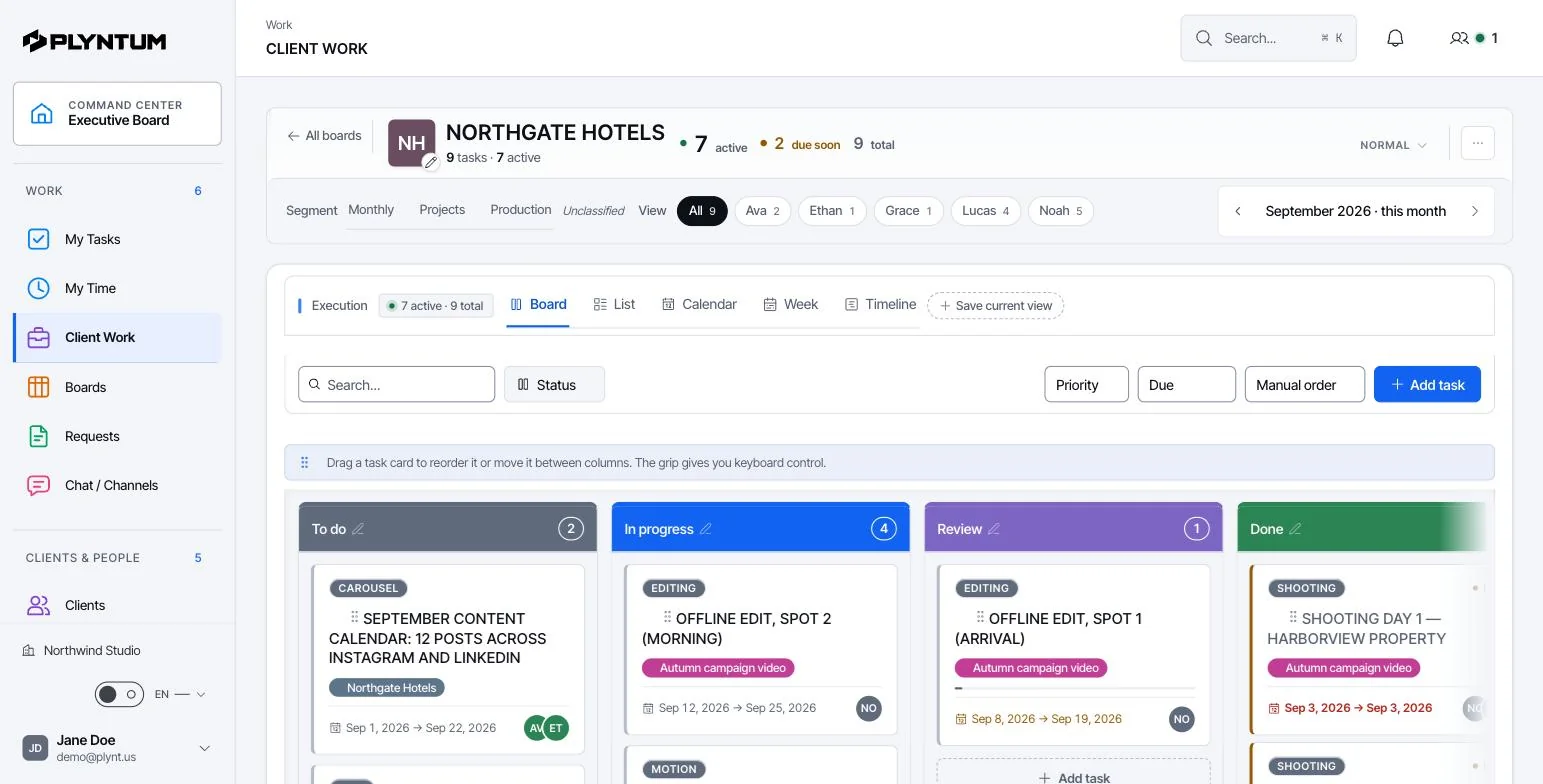
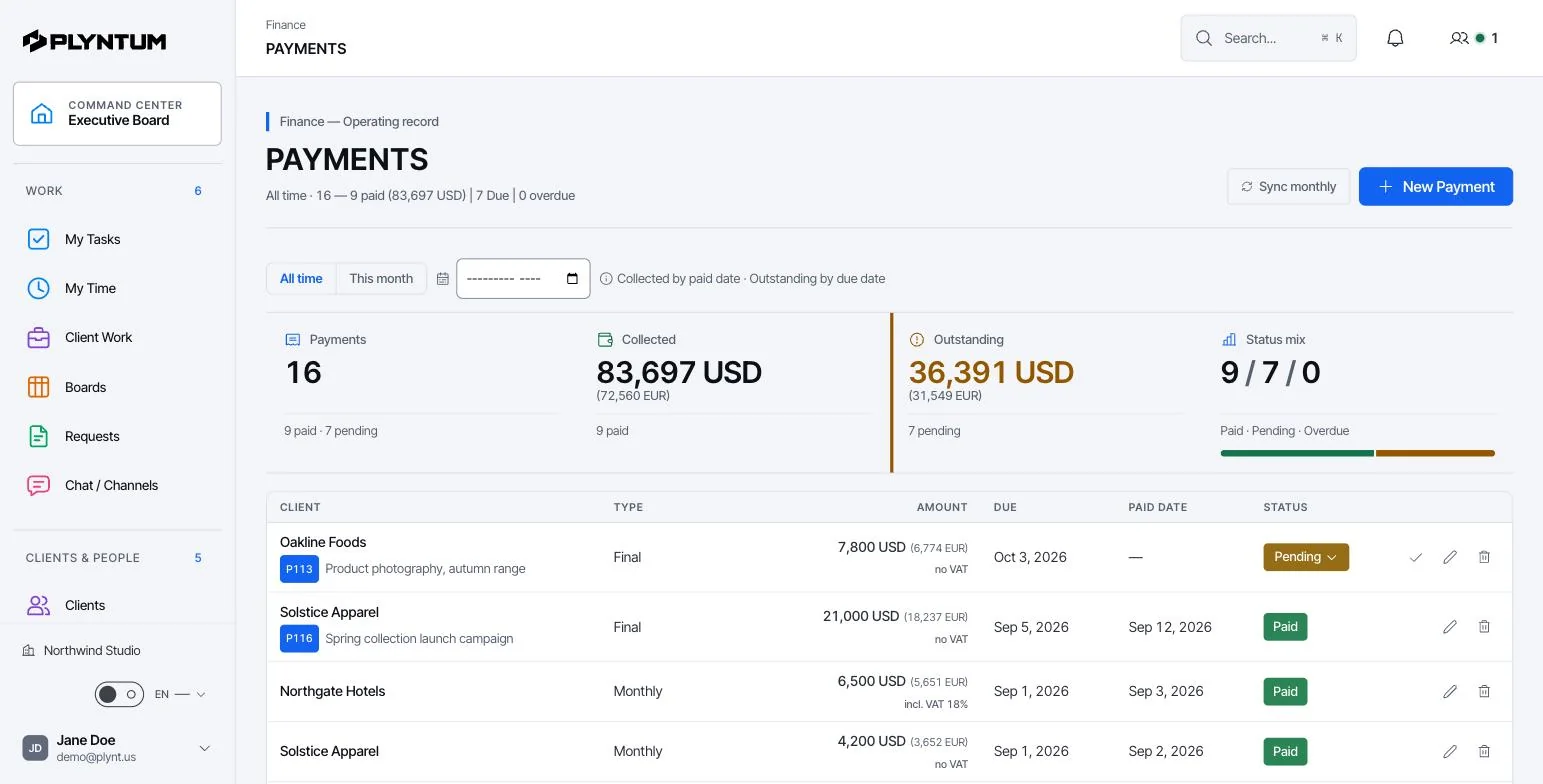
How it looks in PLYNTUM.
Screens from a demo workspace with sample data, as the product looks today.
Common questions
Start with the work that keeps getting stuck.
Bring one project into a connected workspace. See the work, the people and the cost together.